

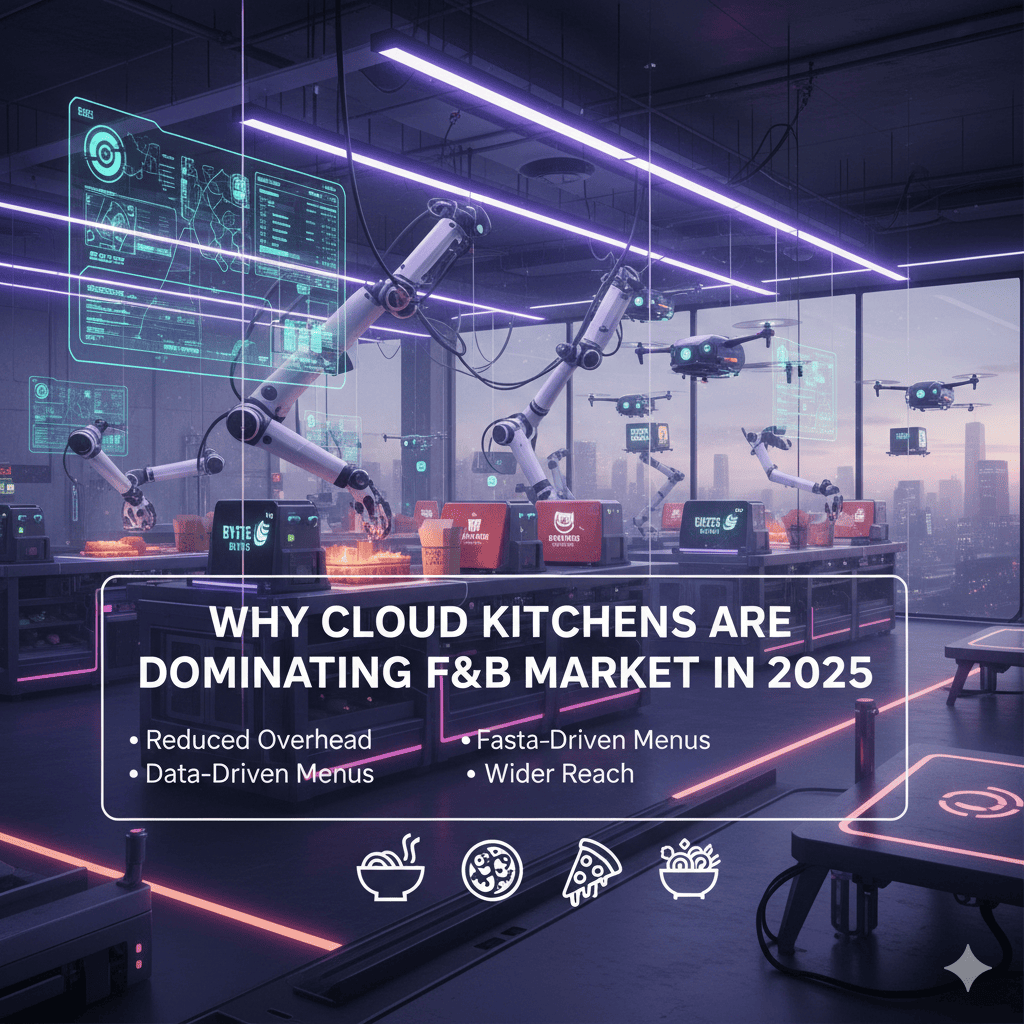
The food & beverage industry is undergoing its biggest transformation in decades. Rising rental costs, changing consumer behavior, delivery-first dining habits, and rapid technological advancements have forced restaurant businesses to rethink traditional models. In this evolving landscape, cloud kitchens have emerged as the most dominant and future-ready business model in 2025.
From startups to established restaurant groups, more brands are shifting towards cloud kitchens to stay competitive, profitable, and scalable. But what exactly is driving this dominance — and why is the cloud kitchen business no longer just a trend, but a necessity?
What Is a Cloud Kitchen?
A cloud kitchen is a professional food preparation facility designed exclusively for delivery and takeaway. By removing the dining room, front-of-house staff, and premium high-street real estate, these “virtual kitchens” focus entirely on operational excellence.
The modern cloud kitchen model relies on four pillars:
Strategic Location: Placed in high-demand delivery zones rather than expensive retail hubs.
Tech-Stack Integration: Seamless connection between POS systems and delivery aggregators.
Data-Driven Menus: Using AI to adjust offerings based on real-time search trends.
Operational Agility: The ability to launch or pivot a brand in days, not months.
The Shift in Consumer Behavior
One of the biggest reasons cloud kitchens are dominating the F&B market in 2025 is how consumers eat today.
Modern customers:
- Prefer convenience over ambience
- Order food online multiple times a week
- Explore new brands digitally rather than physically
- Expect faster delivery and consistent quality
With food delivery platforms deeply embedded into daily life, customers no longer need a physical restaurant experience to trust a brand. This shift has made delivery-first models more relevant than ever.
Rising Costs Are Killing Traditional Restaurants
Opening a traditional restaurant today involves massive capital investment:
- High rent in premium locations
- Interior design and décor costs
- Front-of-house staff salaries
- Utilities and maintenance
In contrast, a cloud kitchen business eliminates most of these expenses. By operating from shared or managed kitchen spaces, brands can:
- Reduce startup costs by up to 60–70%
- Break even faster
- Focus investment on food quality, branding, and marketing
In an uncertain economic climate, this low-risk, high-efficiency model is a major reason for cloud kitchens’ rapid growth.
Why Cloud Kitchens Are More Profitable
Profitability in the F&B industry depends on cost control and operational efficiency — two areas where cloud kitchens clearly outperform traditional setups.
Key profitability advantages include:
- Lower fixed costs
- Optimized staff requirements
- Reduced food wastage through data forecasting
- Better inventory control
Modern cloud kitchens leverage technology and AI-driven systems to track demand patterns, optimize menus, and control food costs — resulting in healthier margins and predictable growth.
The Power of Multi-Brand Cloud Kitchens
One of the biggest advantages of the cloud kitchen model is the ability to operate multiple brands from a single kitchen.
In 2025, successful cloud kitchens are no longer single-brand operations. They run:
- Multiple cuisines
- Different price segments
- Distinct virtual brands
This allows operators to:
- Maximize kitchen utilization
- Serve wider customer preferences
- Test new concepts without high risk
Companies like Kitchen Sharer, which operate 29+ cloud brands, have proven how scalable and powerful this model can be when backed by strong operations and data insights.
AI and Technology: The Backbone of Modern Cloud Kitchens
Technology is no longer optional in the F&B industry — it is the backbone of success.
In 2025, cloud kitchens are using AI-powered systems to:
- Forecast demand accurately
- Optimize inventory levels
- Improve order preparation time
- Reduce food waste
- Analyze customer preferences
AI helps kitchen operators make smarter decisions rather than relying on guesswork. This tech-driven approach is what allows modern food businesses to scale efficiently while maintaining consistency.
Faster Market Entry for New Food Brands
Cloud kitchens have dramatically lowered the barrier to entry for aspiring food entrepreneurs.
Instead of spending months setting up a restaurant, founders can:
- Launch a brand within weeks
- Test menus in real market conditions
- Pivot concepts quickly based on data
- Scale successful brands rapidly
This agility has made cloud kitchens the preferred launchpad for new-age food brands in today’s competitive F&B market.
Consultancy & Managed Operations Are Fueling Growth
Another reason cloud kitchens are dominating in 2025 is the rise of managed kitchen models.
Instead of struggling with operations, many brands partner with expert operators who:
- Provide kitchen infrastructure
- Handle daily operations
- Offer menu engineering support
- Manage staff, procurement, and compliance
End-to-end consultancy and operational management allow founders to focus on brand vision and growth, while experienced teams ensure execution excellence.
Cloud Kitchens Are Built for Scalability
Scalability is where traditional restaurants struggle — and cloud kitchens thrive.
Expanding a traditional restaurant requires:
- New locations
- High capital investment
- Complex staffing
- Longer setup timelines
Cloud kitchens, on the other hand, can expand by:
- Adding new virtual brands
- Replicating kitchens across locations
- Using centralized systems and SOPs
This makes cloud kitchens the most scalable F&B business model in 2025.
The Future of the F&B Industry Is Cloud-Driven
Looking ahead, cloud kitchens are not replacing restaurants — they are redefining how food businesses operate.
The future belongs to models that are:
- Asset-light
- Tech-driven
- Data-backed
- Customer-focused
As consumer behavior continues to evolve and competition intensifies, cloud kitchens provide the flexibility, efficiency, and profitability required to survive and grow.
Final Thoughts / Conclusion
The dominance of cloud kitchens in the F&B market in 2025 is no coincidence. It is the result of:
- Changing dining habits
- Rising operational costs
- Technological innovation
- The need for scalable, low-risk business models
For entrepreneurs, investors, and established brands alike, cloud kitchens are no longer an alternative — they are the smartest way forward
.Ready to Launch Your Virtual Brand?
The transition to a cloud-based model can be complex, but you don’t have to do it alone. Whether you’re looking for kitchen infrastructure or expert consultancy to optimize your operations, we are here to help.